Showing posts with label Symphony of Science. Show all posts

Wednesday, May 30, 2012

Mystery and Awe


If you give me the right man in any field, I can talk to him, I know what the condition is. That he did whatever he did as far as he can go. That he studied every aspect of it as far as he could stretch himself. He is not a dilettante in any way. And so he talked deep, as far as he can go, and therefore he is up against mysteries all the way around the edge, and awe. And we can talk about mystery and awe. That is what we have in common.
That's Richard Feynman, in a Yorkshire Television interview in 1973. It has struck me recently that this is the kind of thing that religion is supposed to have over science, and I just don't believe that for a second. From that same interview:
It is very much more exciting to discover that we are on a ball, half of us sticking upside down and spinning around in space. It is a mysterious force which holds us on. It's going around a great big glob of gas that is fed by a fire that is completely different from any fire that we can make (but now we can make that fire – nuclear fire.)
That is a much more exciting story to many people than the tales that other people used to make up about the universe – that we were living on the back of a turtle or something like that. They were wonderful stories, but the truth is so much more remarkable. So what's the pleasure in physics for me is that it is revealed that the truth is so remarkable, so amazing, and I have this disease – like many other people who have studied far enough to begin to understand a little of how things work. They are fascinated by it, and this fascination drives them on to such an extent that they have been able to convince governments and so on to keep supporting them in this investigation.
Of course, another of my heroes is Carl Sagan.  The idea of approaching mystery and awe, the balance between the two key elements of skepticism and wonder, were a constant theme in his work.  I of course recommend Cosmos and The Demon-Haunted World, but he reached perhaps his greatest crescendo on this topic in Pale Blue Dot.  
Consider again that dot. That's here. That's home. That's us. On it everyone you love, everyone you know, everyone you ever heard of, every human being who ever was, lived out their lives. The aggregate of our joy and suffering, thousands of confident religions, ideologies, and economic doctrines, every hunter and forager, every hero and coward, every creator and destroyer of civilization, every king and peasant, every young couple in love, every mother and father, hopeful child, inventor and explorer, every teacher of morals, every corrupt politician, every "superstar", every "supreme leader", every saint and sinner in the history of our species lived there - on a mote of dust suspended in a sunbeam.The Earth is a very small stage in a vast cosmic arena. Think of the rivers of blood spilled by all those generals and emperors so that, in glory and triumph, they could become the momentary masters of a fraction of a dot. Think of the endless cruelties visited by the inhabitants of one corner of this pixel on the scarcely distinguishable inhabitants of some other corner, how frequent their misunderstandings, how eager they are to kill one another, how fervent their hatreds.
Our posturings, our imagined self-importance, the delusion that we have some privileged position in the Universe, are challenged by this point of pale light. Our planet is a lonely speck in the great enveloping cosmic dark. In our obscurity, in all this vastness, there is no hint that help will come from elsewhere to save us from ourselves.
The Earth is the only world known so far to harbor life. There is nowhere else, at least in the near future, to which our species could migrate. Visit, yes. Settle, not yet. Like it or not, for the moment the Earth is where we make our stand.
It has been said that astronomy is a humbling and character-building experience. There is perhaps no better demonstration of the folly of human conceits than this distant image of our tiny world. To me, it underscores our responsibility to deal more kindly with one another, and to preserve and cherish the pale blue dot, the only home we've ever known.
Once we overcome our fear of being tiny, we find ourselves on the threshold of a vast and awesome Universe that utterly dwarfs — in time, in space, and in potential — the tidy anthropocentric proscenium of our ancestors. We gaze across billions of light-years of space to view the Universe shortly after the Big Bang, and plumb the fine structure of matter. We peer down into the core of our planet, and the blazing interior of our star. We read the genetic language in which is written the diverse skills and propensities of every being on Earth. We uncover hidden chapters in the record of our origins, and with some anguish better understand our nature and prospects. We invent and refine agriculture, without which almost all of us would starve to death. We create medicines and vaccines that save the lives of billions. We communicate at the speed of light, and whip around the Earth in an hour and a half. We have sent dozens of ships to more than seventy worlds, and four spacecraft to the stars. We are right to rejoice in our accomplishments, to be proud that our species has been able to see so far, and to judge our merit in part by the very science that has so deflated our pretensions.
It is sometimes said that scientists are unromantic, that their passion to figure out robs the world of beauty and mystery. But is it not stirring to understand how the world actually works — that white light is made of colors, that color is the way we perceive the wavelengths of light, that transparent air reflects light, that in so doing it discriminates among the waves, and that the sky is blue for the same reason that the sunset is red? It does no harm to the romance of the sunset to know a little bit about it. 
Indeed, this seems to be a common theme among scientists.  Here's Lawrence Krauss:
The amazing thing is that every atom in your body came from a star that exploded. And, the atoms in your left hand probably came from a different star than your right hand. It really is the most poetic thing I know about physics: You are all stardust. You couldn’t be here if stars hadn’t exploded, because the elements - the carbon, nitrogen, oxygen, iron, all the things that matter for evolution - weren’t created at the beginning of time. They were created in the nuclear furnaces of stars, and the only way they could get into your body is if those stars were kind enough to explode. So, forget Jesus. The stars died so that you could be here today. 
I could go on for days, finding expression after expression of just how amazing and wonderful the universe is, how much finding things out brings us right up against the mystery and awe that mark the best in "spirituality".  The Symphony of Science series presents this wonderfully, and the latest video speaks to just the most astounding thing about our origins that I think it's possible to say: We Are Stardust.
I think we can all agree on the importance of mystery and awe. No matter what your religious beliefs, odds are that such things are an inextricable part of them. But why, if it's eminently possible to achieve such things through contemplation of the universe through the methods of science, should we cling to religion so fiercely? I simply don't understand it. The discoveries made in the search for our actual circumstances are readily available to the general public, and I also don't buy the idea that some people "just can't live without religion", that they're somehow not able to "get" science; I have more respect for their intellect than that. Isn't it time we just let go?

Wednesday, October 19, 2011

Stuff. All Of It. No, Really!

In this post, I'm going to show you what I'm really made of.
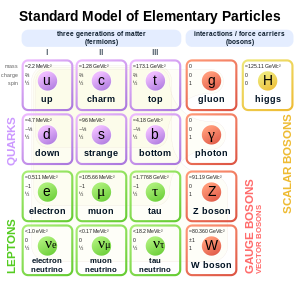
Yep, that's it.  In fact, that's what the universe is made of.  Twelve particles of matter, four fundamental forces.  This is what is called the Standard Model of particle physics.  Everything, absolutely everything, with no exceptions, can be broken down at base into these things.  The interactions of these twelve particles and four forces are the cause of absolutely all phenomena.  We are very close to understanding these interactions to a very high degree of accuracy, and we are also close to being able to plug the numbers into a computer and have it start calculating, and have it end up predicting everything within certain levels of probability.  But obviously, I'm more than just quarks and gluons.  I'm a human being, a living thing, and a thing with a mind.  As Carl Sagan put it, the beauty of a living thing is not the atoms that go into it, but the way those atoms are put together.  So, how did this stuff end up turning into me?

These elementary particles have to come together as composite particles before we can even start to build atoms, which are the smallest pieces of elements.  The nucleus of an atom is made of protons and neutrons, and that nucleus is surrounded by a cloud of electrons.  Yes, its a cloud even in a hydrogen atom, where there is one electron.  Protons and neutrons are made of three quarks each; a proton is two up quarks and a down quark, while a neutron is two downs and an up.  The quarks are held together by one of the four forces, the strong nuclear force (which is also gluons).  The nucleus of a relatively large atom looks a little bit like this:
Now, that's only an approximation, because in reality, all of those particles are in many different places at the same time.  When you look at them, they are only probably going to be in any given place.  These particles are held together by the nuclear force, which is really just the residual bits of the strong force holding the quarks together.  This nucleus, as I noted, is relatively large.  All of the atoms of heavier elements, and by that I mean anything with an atomic number 3 and up, started out as much simpler atoms than this one.  They all looked kind of like this:
That's hydrogen, specifically protium.  It has one proton and one electron, and most of the stuff in the universe still looks like this.  About 75% of the chemical matter in the universe is hydrogen, and about 99.98% of hydrogen is protium.  At one point, you were this.  I was this.  Everything you see was this.  These particles were formed when the universe was born, about 13.7 billion years ago.  So in that sense, you are 13.7 billion years old.  The particles that compose my body are as old as the cosmos.  Obviously, I'm not made of hydrogen.  A big part of me is, because the second most common molecule in the universe is a large percentage of my body.  The most common molecule is of course hydrogen gas, H2.  Helium doesn't form bonds.  The next most common element is oxygen, and since there's a lot of hydrogen and oxygen, they combine to form H2O.  Water.  So I've got a lot of hydrogen in me, but I've got other stuff too.  Obviously, I've just mentioned oxygen.  There's also carbon, iron, and various other elements.  Where did all that come from?  Well, when you put a whole lot of hydrogen together, another force takes over: gravity.  It starts pulling all of the hydrogen into a ball, and crushing it together in the center.  It eventually looks like this:
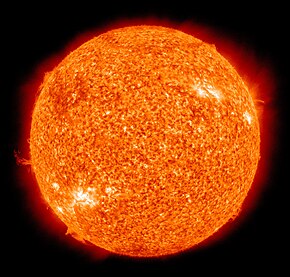
That's a star, specifically our Sun.  Its emitting a lot of energy, partly in the form of heat and light, because in the middle, gravity is pushing the hydrogen atoms together.  Normally, they're held apart by the electromagnetic force, which is much weaker than the strong nuclear force, but holds up better over distance.  Gravity is much weaker than the electromagnetic force, but its even better at working at a distance, and the more matter you have, the stronger it gets.  When a proto-star gets big enough, the gravity pushes the nuclei close enough that the strong nuclear force beats out electromagnetism, and the atoms snap together in a process called thermonuclear fusion.  The energy the particles release when they fuse is greater than the energy needed to push them together, and the star ignites.  At its core, our Sun and every other star is fusing hydrogen into helium.  Our Sun, amazingly enough, isn't big enough to go on to the next stage when it eventually runs out of hydrogen.  Bigger stars start fusing hydrogen into carbon through the triple-alpha process when they near the end of their lives.  Really big stars go on to fuse lighter elements into iron.  But going any heavier than that stops releasing energy; it takes more energy to fuse the nuclei than they release when it happens.  So what made all the elements heavier than iron?  There are a lot of them.  That process might look a little something like this:
The incredibly huge stars explode when they reach the end of their lives; they've fused everything they can into iron, and something has to give.  Fusion isn't making more energy, but gravity just won't let up.  They release truly apocalyptic amounts of energy in what is called a supernova.  Such a destructive event would wipe out all life in every nearby solar system.  Whole planets would be utterly destroyed, and even other stars might be swept up in the massive explosion.  Supernovae observed from Earth can outshine the entire galaxy in which the star resides.  One explosion outshining hundreds of billions of stars.  But in the midst of all that energy being released, lots of atoms are being slammed together with tremendous force.  And we get supernova nucleosynthesis.  All the heavier elements, everything with an atomic number higher than 56, gets made when the biggest of stars die.  Stars that burned billions of years ago and uncounted light years away died, so that you could be here today reading this article.  On YouTube, philhellenes said it quite well:  Stars must die so that I can live.  I stepped out of a supernova.


And so did you.


So, what am I really made of?  Energy.  Quarks.  Atoms.  Molecules.

Stars.

I'm pretty awesome.  You are, too.

Saturday, September 10, 2011

Finding Meaning in the Universe

I haven't found a lot of time lately to write, which is unfortunate.  Thankfully, I've done some writing in the past, and I find myself referencing this particular piece a lot.  I've been hanging out at r/atheism lately, and this question popped up recently:


"My entire teen years were spent on philosophical pondering and being REALLY stressed over what world view I could accept. I would form one, think critically on it until it collapsed, modify it, and repeat the process until I arrived at Atheist. I also did a fair amount of reading, most notably of Sophie’s World, which if you don’t know is a really easy primer for most major philosophers. This wide range of thinking has left me with a bit of a problem.
I am now a condescending bitch.

Now when I read things that have been hailed as “brilliant” or “profound” or “mindblowing” I am left with the reaction of “dude, I knew about this when I was 14.” For example,
-I finally read Watchman this year and was REALLY disappointed. I was hoping for something controversial, thought-inducing, worth all the hype it got. Instead I just responded with “this seems kinda trivial, and Ozymandias’ great fix wouldn’t work anyway because we have world disasters all the time and its never brought about world peace.” 
-When my ex-bf had an existential crisis over the idea of what happens after death I wanted to punch him for being so immature because to me, duh, it’s the same as before you were born. 
-I once heard someone I know to be a fairly devout Protestant say “man, Eastern religions will blow your mind, its stuff that I have never even thought about” and was appalled because when I first learned about Hinduism I was amazed at how much it lined up with conclusions I had drawn myself.
-When I hear theists agonizing over some ambiguous religious doctrine, or how a good diety could let bad things happen I am amazed that they didn’t resolve that question in their mind years ago because it seems so core to any belief in God.
Long story short, philosophy now seems really boring, and almost juvenile, to me largely because I learned so much about it when I was younger. Does anyone else have these side-effects from learning to think critically?"

I realized exactly how this person felt, and I wrote up a response.  I thought I'd share it here.

It sounds like you took an evolutionary approach to your philosophy, which is awesome. You're finding yourself at a point many of us reach, and in which I was sitting myself until not long ago. Nothing looks remarkable any more, everything is dull and boring, because all you have is the real world. And what fun is there in just reality?
In college, I took classes in ethics and religion under Dr. David Belcastro, and I expressed to him the thought that the ultimate point of philosophy was to ask "why". He told me that religion, in all of its various forms, has an answer: "Yes." I've been trying to understand that for about 6 years now, and I think I finally do. Oddly, I found the answer outside of religion entirely.
Read some Carl Sagan, particularly Pale Blue Dot and The Demon-Haunted World, or watch Cosmos. Watch the Symphony of Science videos, or any interviews/lectures with Carl Sagan or Richard Feynman. The universe is a wonderful place, it is remarkable in its vastness and complexity, and is enough in itself to inspire awe and wonder. You're seeking spiritual fulfillment, but religion isn't going to help. That same fulfillment can be found in science, by coming to understand the way the world actually is.
We here on Earth think we're amazing beings. And we are, there's no question about that. But we're also tiny, virtually insignificant on a cosmic scale. Take a look at the Pale Blue Dot picture; really look at it. That tiny speck, a small part of one pixel, is us. All of us. A mote of dust, suspended in a sunbeam. Everyone you know, everyone you love, everyone who has ever lived, lived on that tiny point of blue light. That should give you the feeling of humility you need.
Then, look at yourself. Think about the things that are going on inside you, every moment. There are trillions of cells, each one made up of tiny molecular machines, inside every human being. Every cell was built through billions of years of evolution, and look at the amazing result: you. And then realize that as you're thinking this, you're using your brain; a three pound mass of jelly that you could hold in your hands, but that unappealing object is capable of contemplating the vastness of space, capable of contemplating infinity, and capable of contemplating itself contemplating infinity.
Finally, those molecules that make up your body are made of atoms of various types. Every single one that is heavier than hydrogen or helium was synthesized during the death of a star, billions of years ago and light-years away. You, and me, and everyone else, and everything you see, are made of stars. We are connected to the universe in the very deepest manner possible. Dr. Belcastro, in his Introduction to Religion class, focused on religion as reconnecting; that's the root of the word, in fact. Its the same root as "ligament." Religion seeks to connect us to the universe, to show us our place in the cosmos. But religions make up connections, they tell stories that have no evidence but that sound comforting until you see through them. Science has the evidence, and it tells us we really are connected. To each other and to every other living thing through biology, to the Earth through chemistry, and to the rest of the universe on an atomic level. For me, I don't need anything else to look at the world and finally, for the first time in years, really say "wow."